

Architecting
SET posses many years of success records in the field of architecture developments and provides clients with the consulting services for system developments (or enterprise improvements or innovations) to ensure the following benefits:
According to ISO/IEC/IEEE 42010 “Systems and software engineering - Architecture description,” architecture and architecture framework are defined as follows:
Architecture: fundamental concepts or properties of a system in its environment embodied in its elements, relationships, and in the principles of its design and evolution.
Architecture framework: conventions, principles and practices for the description of architectures established within a specific domain of application and/or community of stakeholders.
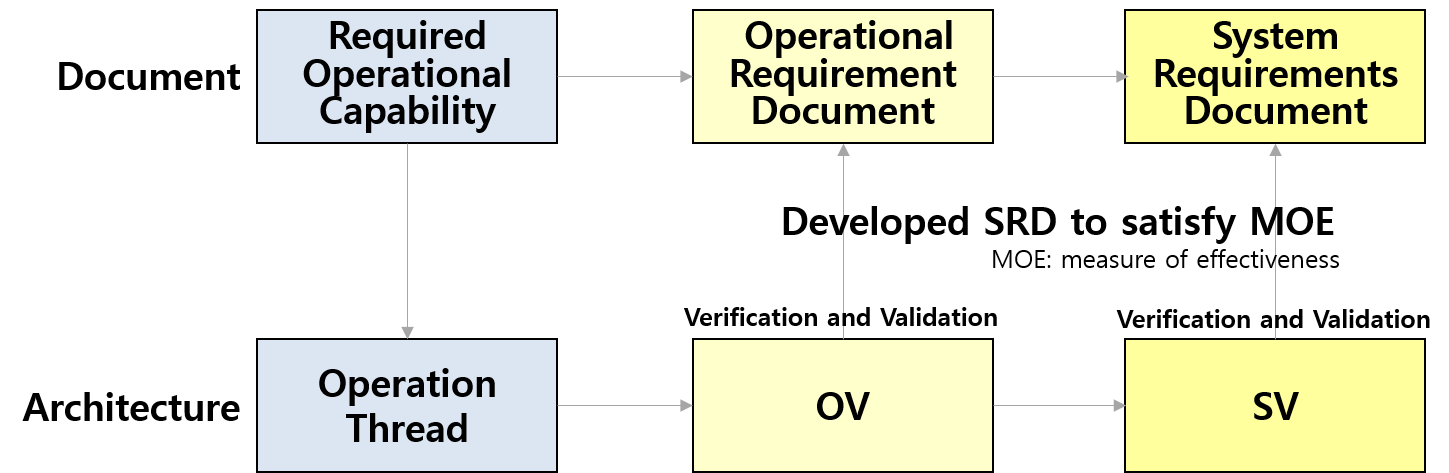
Architectures are built to articulate essential design elements and attributions of system-of-interest, which life cycle stakeholders share to make use of communications based on common understanding, system developments and operations, clear identification of requirements from operations or activities for evolution, identification of alternative solutions, operations without defect, maintenance activities, and system specification development to meet the MOE (Measures of Effectiveness).
The scope of architecture developments includes both operational views (OV) and system views (SV) according to architecture framework viewpoints.
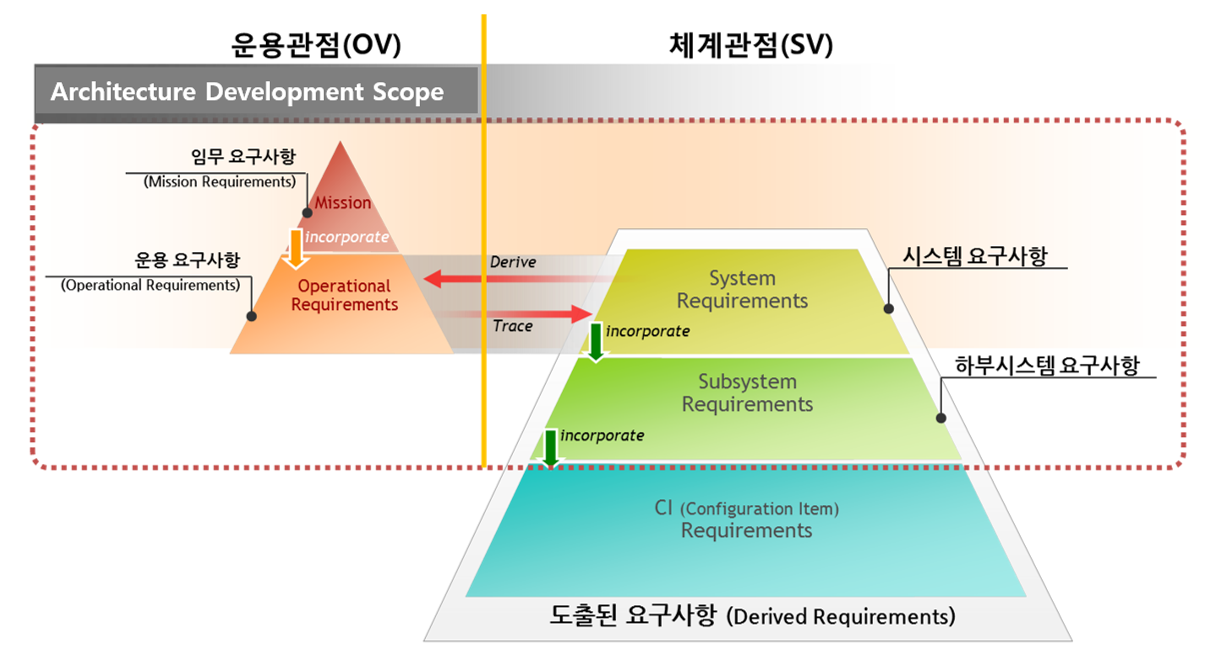
The purpose of OV architecture developments is to achieve completeness of problem domain definition through defining operational requirements in the context of entire operations based on the operational scenarios derived from mission requirements. The OV architecture allows you to determine whether to achieve or not the effectiveness of system-of-interest against the component of MOE defined by operational views.
The purpose of SV architecture developments is to draw system level functional and performance specifications, and thus these functional and performance requirements define system MOP (Measures of Performance) to provide the traceability to MOE defined by operational views.
Generic architecture development processes consist of the order of problem domain definition, OV developments, and then the solution domain definition of SV developments. According to the above mentioned, the architecture development processes can be simplified as below in details:
Architectures derived from the processes mentioned above may:


Tel.+82-2-855-1198, Add. #1711 (ACE GASAN TOWER), 121, Digital-ro, Geumchon-gu, Seoul 08505, Korea
Copyright (c)2000 SETechnology All Right Reserved.
2sisstore
